⚠️ Source-confidence note: the dish and its core technique are very well documented. Town-level differences (Nablus, Jerusalem, Gaza, and Jordanian vs Syrian style) come mostly from cooks' and food writers' accounts rather than systematic studies. They are reported here as such.
01Geographic & Texture Profile
- Primary Geographic Zone: All of Palestine (Jerusalem, Nablus, Hebron, Gaza, Galilee), and equally Jordan and Syria. It is also cooked in Lebanon and Iraq.
- Liquid & Texture Profile: Seco (dry, separate grains). All the broth is absorbed, so the moulded rice holds its shape when the pot is turned over.
- Traditional Cooking Vessel & Fuel: A deep, straight-sided pot (tanjara or ṭunjara) on a gas or wood flame. It is inverted at the table onto a large round tray (siniyyeh).
02Historical & Cultural Context
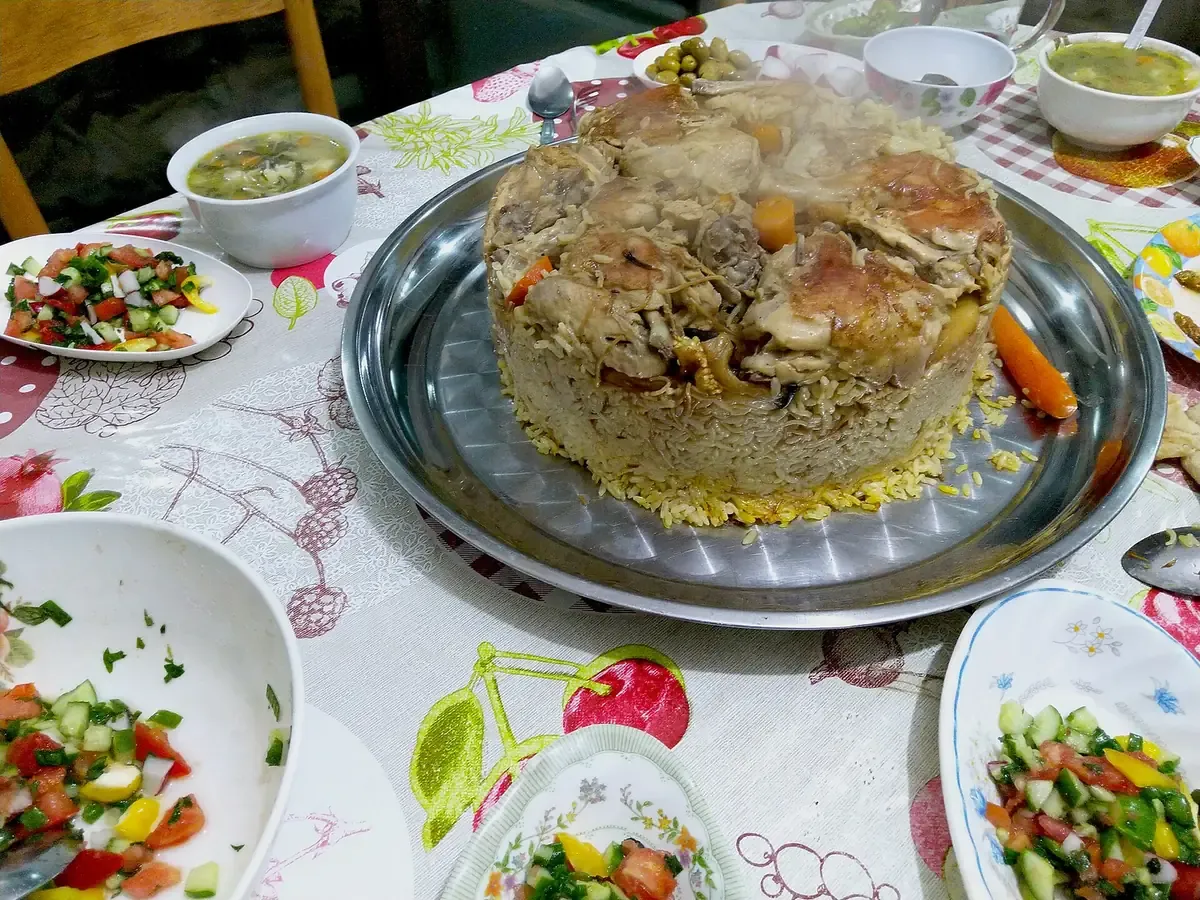
Maqluba means "upside-down". The pot is turned over at the table, and the layers of meat, fried vegetables and spiced rice stand like a cake. Elihu Grant's 1921 description already explained the name as "turned over". The earliest written maqluba is in the 13th-century Baghdadi cookbook Kitāb al-Ṭabīkh, but there it is a different, egg-based dish. A Palestinian folk tale says Jerusalemites served a vegetable-and-eggplant dish called bathinjaniyya to Salah al-Din after he took the city in 1187, and that he asked about this "maqluba". No historical record supports the story, but it is told everywhere. The dish is a fixture of Friday lunches and of Ramadan iftars. It has also become a symbol of Palestinian identity: Jerusalemites have cooked and shared it in collective meals at al-Aqsa, and it is served at solidarity gatherings abroad.
Maqluba is layered. Chicken or lamb poached in a spiced broth goes at the bottom, then deep-fried vegetables (eggplant, cauliflower, potato, tomato, sometimes carrots), then soaked rice. The meat broth is poured over everything. Culinary science: frying the vegetables first concentrates their sugars and gives them enough structure to survive 40 minutes of steaming without collapsing. The rice is soaked so that it hydrates evenly in the limited broth. A rest of 10–20 minutes after cooking lets starch set at the edges, so the turned-out "cake" holds together. Like the Valencian arroz con costra, it is a festive rice with a dramatic final step at the table.
03Local Town-by-Town Variations
- Nablus & Jabal Nablus: Many households favour cauliflower, alone or alongside eggplant. A Nablus-raised cook reports making it in season with 'akkoub (gundelia, a wild thistle), and in spring with cauliflower and broad beans.
- Jerusalem (al-Quds): Families sometimes add vermicelli (sha'riyyeh) and chickpeas to the rice. Eggplant is the vegetable of the Salah al-Din legend.
- Gaza: Typically spicier, and the vegetables follow what the market has. A recipe from a Gaza office cook uses chicken with potato, eggplant, onion and tomato, seasoned with allspice, cardamom and cinnamon, and topped with fried almonds. It is served with fattoush.
- Coastal cities (Yafa, Gaza, Akka): Fish sometimes replaces meat. This is close to sayadieh, documented on the Lebanon page.
- Jordanian style: Food writers describe it as less oily and more restrained, with clean, distinct layers for formal feasts. It is commonly made with lamb and served with yogurt. ⚠️ This is a writer's characterisation, not a documented standard.
- Syrian style: Eggplant-led and lamb or chicken. ⚠️ No source found that documents a distinct Syrian technique.
| Variable | Nablus | Jerusalem | Gaza |
|---|---|---|---|
| Lead vegetable | Cauliflower (± eggplant), 'akkoub in season | Eggplant | Potato + eggplant + onion |
| Extras | Broad beans (spring) | Vermicelli, chickpeas | Chilli heat; almonds on top |
| Meat | Chicken or lamb | Chicken or lamb | Chicken (fish on the coast) |
04The Master Recipe (4-Person Batch Blueprint)
Variant represented: chicken with eggplant and cauliflower (Nablus/Jerusalem household style). The Gaza method is noted.
The Flavor Base (El Fondo) (the broth / maraq)
| Ingredient | Quantity |
|---|---|
| Chicken, in 8 pieces (or 1 kg lamb shoulder on the bone) | 1.2 kg |
| Water | 1.6 L |
| Onion, halved | 1 |
| Bay leaves, cardamom pods, cinnamon stick | 2 / 4 / 1 |
| Allspice (ground) | 2 tsp |
| Cinnamon, turmeric, black pepper (ground) | 1 tsp each |
| Salt | to taste |
Simmer the chicken with the onion and whole spices for 35–40 min, skimming (lamb: 75–90 min). Lift out the meat and strain the broth. You need ≈ 900 ml.
Assembly Ratios
| Element | Quantity |
|---|---|
| Rice (Egyptian/Calrose medium grain, or basmati), soaked 20–30 min | 400 g |
| Broth over the rice | ≈ 800–900 ml (≈ 2 : 1 by volume, liquid ≈ 2 cm above the rice) |
| Eggplant, 1.5 cm rounds, salted 20 min | 2 medium (600 g) |
| Cauliflower, florets | 1 small (500 g) |
| Potato, 1 cm rounds (optional) | 1 |
| Tomato, thick slices (pot base) | 2 |
| Oil for frying | as needed |
| Rice spices: allspice, turmeric, cinnamon | 1 tsp / ½ tsp / ½ tsp |
| Garnish: toasted pine nuts and/or almonds; parsley | 60 g |
| To serve: plain yogurt and Arab salad | — |
Step-by-Step Cooking Blueprint
- Preparation: Make the broth. Salt, rinse and dry the eggplant. Soak the rice.
- Frying: Deep- or shallow-fry the eggplant, cauliflower and potato until deep golden, then drain.
- Layering: Oil the pot base and lay down the tomato slices. Add the meat, then the cauliflower, potato and eggplant packed tight. Drain the rice, mix it with the rice spices and spread it evenly on top. Press down gently.
- Liquid Addition: Lay a small inverted plate on the rice and pour the hot broth over it slowly so the layers stay put. The liquid should sit about 2 cm above the rice.
- Fire Manipulation: Bring to a boil and cook 10 min on high, uncovered. Then cover and cook on very low heat for 30–35 min until all the liquid is absorbed.
- Finish/Resting Phase: Off the heat, rest covered for 10–20 min. Set the tray over the pot, flip it in one move, wait 1–2 min, then lift the pot. Scatter nuts and parsley on top. Serve with yogurt and salad. [Gaza: boil for 10 min, then very low heat for 30 min; invert and rest 20 min before lifting.]
05Authority Reference Links
- Wikipedia – Maqluba
- Anera – Ramadan recipes from Jerusalem to Gaza City (Sabah's maqluba, Gaza office)
- Gulf News – Palestinian cuisine: it's time for maqluba and freekeh to reach tables worldwide
- Little Sunny Kitchen – Maqluba (Nablus, Jerusalem and Gaza family variations)
- Mawdoo3 – طريقة عمل المقلوبة الفلسطينية
- Ckbk / The Gaza Kitchen – Upside-down rice, lamb and vegetables
- Al Jazeera – A displaced Palestinian man cooks maqlouba during wartime for his family
- Legal Nomads – Maklouba (Jordanian context)
รูป: Ramadan9044 · CC BY-SA 4.0 · จาก Wikimedia Commons