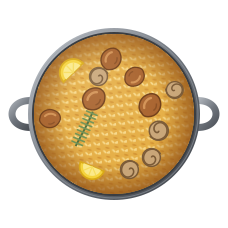
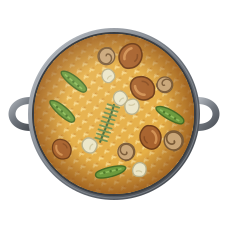
⚠️ Source-confidence note: the best-documented arroz con conejo y caracoles belongs to Murcia and Alicante (see the Alicante cousin, recipe_arroz_conejo_y_caracoles.md). For the Ebro valley I found rabbit-and-snail stews (Riojan conejo con caracoles, Aragonese conejo en salmorejo served with rice) and a strong snail culture (Haro, Lleida border), but no canonical rice recipe. This file is a reconstruction from those traditions.
01Geographic & Texture Profile
- Primary Geographic Zone: The middle Ebro valley: La Rioja (Haro, Logroño), the Ribera de Navarra (Tudela), Bajo Aragón (Alcañiz, Caspe), and the Aragonese edge of the Franja and Lleida.
- Liquid & Texture Profile: Meloso (creamy). Ebro rices are generally wetter than Alicante's sarmiento paellas.
- Traditional Cooking Vessel & Fuel: A clay cazuela or paella over vine-shoot (sarmiento) fire in wine country.
02Historical & Cultural Context
Snails (caracoles, cargols) are a deep-rooted festival food along the Ebro. In La Rioja they are a Christmas Eve dish, still held in esteem in Haro. Rabbit is the standard small game of the dry steppe (Monegros, Bardenas). Aragón also grows rice along the lower Ebro and the Cinca (with Huesca and Zaragoza paddies), so a rice of rabbit and snails is the natural intersection. In Riojan wine country the vine-shoot fire links it directly to the Pinoso tradition in Alicante.
Culinary science: snails need purging and long pre-cooking. Riojan snails are typically served in a spicy tomato-chorizo sauce, and that sauce makes a powerful sofrito for rice. Ebro rices often use meat stock and a stirred finish, giving a meloso texture.
03Local Town-by-Town Variations (Crucial — reconstructed)
- Haro / Rioja Alta: Snails in the Riojan sauce (tomato, choricero pepper, chorizo, guindilla) form the base. Rabbit browned separately. Sarmiento fire.
- Tudela / Ribera de Navarra: Rabbit + snails + vegetables of the Ribera (artichoke, cogollos), lighter on chorizo.
- Bajo Aragón (Alcañiz): Rabbit + snails + Bajo Aragón olive oil + rosemary. Closest to the Valencian style.
- Monegros (Aragón): Rabbit "de monte" with thyme. The steppe tradition (see the RENC Aragón supplement on forgotten Monegros game dishes).
04The Master Recipe (4-Person Batch Blueprint)
Variant represented: Rioja Alta (snails in Riojan sauce + rabbit).
The Flavor Base (El Fondo)
| Ingredient | Quantity |
|---|---|
| Rabbit, jointed | 1 (≈ 1.1 kg) |
| Snails, purged & blanched | 400 g (in shell) |
| Olive oil | 80 ml |
| Onion | 1 |
| Garlic | 3 cloves |
| Choricero pepper pulp (or 1 tbsp pimentón) | 2 tbsp |
| Chorizo riojano, sliced | 80 g |
| Guindilla | 1 |
| Ripe tomato, grated | 250 g |
| Rabbit/chicken stock | 1.6 L |
| Rosemary / thyme | 1 sprig |
Extraction: Brown the rabbit (15 min) and set it aside. Fry the chorizo, onion (10 min) and garlic, then the choricero pulp, guindilla and tomato (10 min). Add the snails and rabbit, then the stock and herbs. Simmer 25 min.
Assembly Ratios
| Element | Quantity |
|---|---|
| Round rice | 340 g |
| Broth | ≈ 1.4 L (≈ 4:1) |
Step-by-Step Cooking Blueprint
- Rice: Add the rice to the boiling broth.
- Fire: Strong for 8 min → medium for 9 min, stirring gently 2–3 times.
- Finish: Rest 2 min. Serve with crusty bread for the snail sauce.