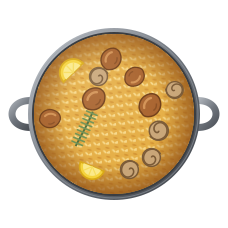
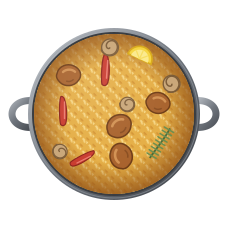
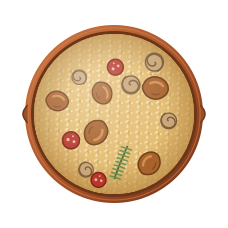
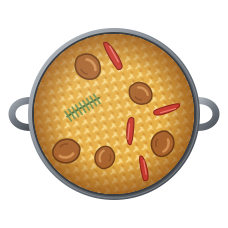
01Geographic & Texture Profile
- Primary Geographic Zone: L'Horta de València, La Ribera Alta & Baixa (Sueca, Cullera, Alzira, Algemesí), Camp de Túria, and the rice fields around L'Albufera. It is cooked across the whole Comunitat, but these are the areas with the strongest claim.
- Liquid & Texture Profile: Seco (dry). A thin layer of separate grains with a socarrat (caramelised crust) on the base.
- Traditional Cooking Vessel & Fuel: A flat, two-handled polished-steel or enamelled paella (the pan is the "paella"; a paellera is the cook). It sits on a paellero tripod over a wood fire: orange-tree prunings (llenya de taronger) in L'Horta and La Ribera, vine shoots (sarments) towards Utiel-Requena, and pine or olive wood in the interior.
02Historical & Cultural Context
The paella valenciana was born as a field-worker's midday meal in the rice-growing marshes around L'Albufera, which have been cultivated since Andalusi irrigation (the séquies) reached their full extent. Labourers cooked whatever the horta and the marjal provided in a wide shallow pan over a wood fire: rabbit, free-range chicken, sometimes water vole (rata de marjal) or duck, snails (vaquetes) and the two key legumes, bajoqueta (flat green bean, "ferraura") and garrofó (large white lima bean). Saffron, which grew locally, gave colour. By the 19th century it had become the Sunday family dish of rural Valencia, and the shallow pan had taken on the name of the dish.
There is an ongoing debate about the canonical ingredient list. In its survey of more than 170 restaurants and many amateur cooks across Valencian towns, the Wikipaella initiative concluded that a shared core exists but town-level additions are legitimate. That core is rice, chicken, rabbit, garrofó, bajoqueta, tomato, olive oil, saffron, salt and water. Accepted "town" additions include snails, artichoke (in winter), duck, pimentón, rosemary and ajo tierno. Chorizo, onion and seafood are generally rejected. The academic study "A nightmare glocal discussion: what are the ingredients of paella valenciana?" surveyed 400 home cooks from 266 towns and reached the same core list of ten ingredients.
Culinary science: the wide, shallow pan maximises evaporation. That lets a seco rice reduce to a thin bed in which each grain absorbs a broth concentrated by browning (the meat's Maillard reaction) and by long reduction (the fondo). Valencian short-grain varieties such as Senia, Bahía, Albufera and Bomba, protected by D.O. Arròs de València, absorb a lot of liquid while staying intact. The socarrat forms in the last 1–2 minutes, when the remaining water evaporates and the starch and sugars touching the steel caramelise. Wood fire matters because its broad, uneven flame heats the whole pan, including the rim, which a domestic burner cannot do.
03Local Town-by-Town Variations
- The Sueca / Ribera Baixa Style (the rice-field school): Very little or no pimentón. Grated tomato only, no tomato paste. Some households add duck (ànec) alongside chicken and rabbit, a nod to Albufera hunting. In season (Nov–Mar) the artichoke often replaces or joins the bajoqueta. Rice is cooked about 17–18 min with no stirring after the rice goes in. Sueca hosts the Concurs Internacional de Paella Valenciana, which enforces a strict ingredient list.
- The L'Horta Nord / Benissanó–Camp de Túria Style: Vaquetes (small hedge snails, Iberus) or caracoles serranos are standard. A sprig of rosemary goes into the broth for the last few minutes and is then removed. Pimentón is used, in a small pinch, before the tomato. The tradition here is to fry the garrofó briefly with the green beans before adding the tomato.
- The Alzira / Ribera Alta Style: Rabbit and chicken are browned for longer and more slowly (≈25 min) to build a darker fondo. Some families add pebre roig and a few strands of saffron at two moments, in the broth and again with the rice.
- The Interior / Utiel-Requena & La Serranía Style: The fuel is sarmiento (vine shoots), which gives a fierce, fast heat. Chicken may be omitted for rabbit + snails + rosemary. The heavier fire produces a stronger socarrat. This is close to the "arroz de monte" logic covered in recipe_arroz_conejo_y_caracoles.md.
- The Winter Variant (anywhere in the province): Paella amb carxofes. Quartered artichokes rubbed with lemon go in with the beans. Many cooks also add pèsols (peas) in spring.
| Variable | Sueca / Ribera Baixa | Horta Nord / Benissanó | Alzira / Ribera Alta | Utiel-Requena interior |
|---|---|---|---|---|
| Meats | Chicken, rabbit (± duck) | Chicken, rabbit | Chicken, rabbit | Rabbit (± chicken) |
| Snails | Rare | Vaquetes standard | Optional | Serranos, standard |
| Pimentón | None or trace | Small pinch | Yes | Yes |
| Rosemary | No | Yes (last 3 min) | Optional | Yes |
| Fuel | Orange wood | Orange / pine | Orange wood | Sarmiento |
04The Master Recipe (4-Person Batch Blueprint)
Variant represented: L'Horta / Ribera consensus core (Wikipaella core list + optional snails and rosemary from Horta Nord).
Pan: 55 cm paella (about 4–5 people). Mark the rivets (clavos) on the handles, which act as the water-level guide.
The Flavor Base (El Fondo)
| Ingredient | Quantity |
|---|---|
| Extra-virgin olive oil | 90 ml |
| Free-range chicken, jointed into 8–10 pieces | 800 g |
| Rabbit, jointed | 500 g |
| Salt (for searing) | 6 g |
| Bajoqueta / ferraura (flat green beans), in 4 cm pieces | 200 g |
| Garrofó (fresh, or dried & soaked 12 h) | 150 g fresh / 100 g dried |
| Ripe tomato, grated | 150 g |
| Pimentón dulce (sweet paprika) | 3 g (1 tsp), optional by town |
| Water | ≈ 1.6 L (to the rivets) |
| Saffron threads (or 1 sachet colourant + 4–5 threads) | 0.3 g |
| Pre-cooked vaquetes (optional, Horta Nord) | 12–16 |
| Rosemary sprig (optional) | 1 |
Extraction process:
- Level the pan and heat the oil. Salt the oil around the edge.
- Put the chicken and rabbit in the centre. Brown them over medium-high heat, turning, for 20–25 min until deep golden. This sofregit of meat is the main flavour driver.
- Push the meat to the rim. Fry the beans and garrofó in the centre for 4–5 min.
- Make a well. Add the pimentón for 5 seconds only, then immediately add the tomato so the paprika doesn't burn. Fry until the tomato loses its water and darkens to a jammy paste (5–7 min).
- Add water up to the rivets (≈1.6 L). Add the saffron and snails. Bring to a boil, then simmer for 25–30 min. The liquid will reduce to ≈1.2 L. Taste and correct the salt now: the broth should be slightly over-salted, because the rice will absorb it.
Assembly Ratios
| Element | Quantity | Note |
|---|---|---|
| Short-grain rice (D.O. Arròs de València: Senia / Bahía / Bomba) | 400 g | ≈100 g per person |
| Broth in the pan when the rice goes in | 1.2 L (Senia/Bahía) – 1.4 L (Bomba) | Ratio ≈ 1:3 by weight for Senia, 1:3.5 for Bomba |
| Total meat | 1.3 kg | Bone-in |
| Vegetables | 350 g | Beans + garrofó |
Step-by-Step Cooking Blueprint
- Preparation: Joint the meat, string the beans, soak dried garrofó overnight and grate the tomato. Light the fire 20 min ahead so that a bed of embers is ready.
- Searing (Fondo): As above. Keep the fire spread under the whole pan.
- Liquid Addition & Reduction: Simmer the broth until it has reduced to the target volume. Check the level against the rivets.
- Rice Addition ("Echar el arroz"): Scatter the rice in a cross pattern (en caballón) over the pan, then spread it evenly with the spoon in one pass. Do not stir after this point.
- Fire Manipulation:
- Minutes 0–8: High heat across the whole pan. The broth should boil vigorously over the whole surface.
- Minutes 8–16: Medium-low. Pull the embers to the centre and let the rim cook on the residual heat. Add a rosemary sprig now if you are using it.
- Minutes 16–18: Raise the heat briefly for the socarrat. Listen for crackling and smell for toast, not burning. Lift a grain at the edge with the spoon to check.
- Finish/Resting Phase: Take the pan off the fire, remove the rosemary and rest for 5 min. Cover with a clean cloth or newspaper if you like. Traditionally everyone eats straight from the pan, each person working their own wedge.
05Authority Reference Links
- Visit València – The Valencian Paella Recipe (official tourism board)
- Guía Michelin – Uno de nuestros platos más internacionales: la paella
- Comunitat Valenciana Turisme – Paelles i arrossos: varietat i bon gust (VA)
- Google Arts & Culture – Valencian Paella
- Que.es – Así se hace la paella valenciana auténtica
- The Takeout – the two unexpected ingredients (rabbit & garrofó)