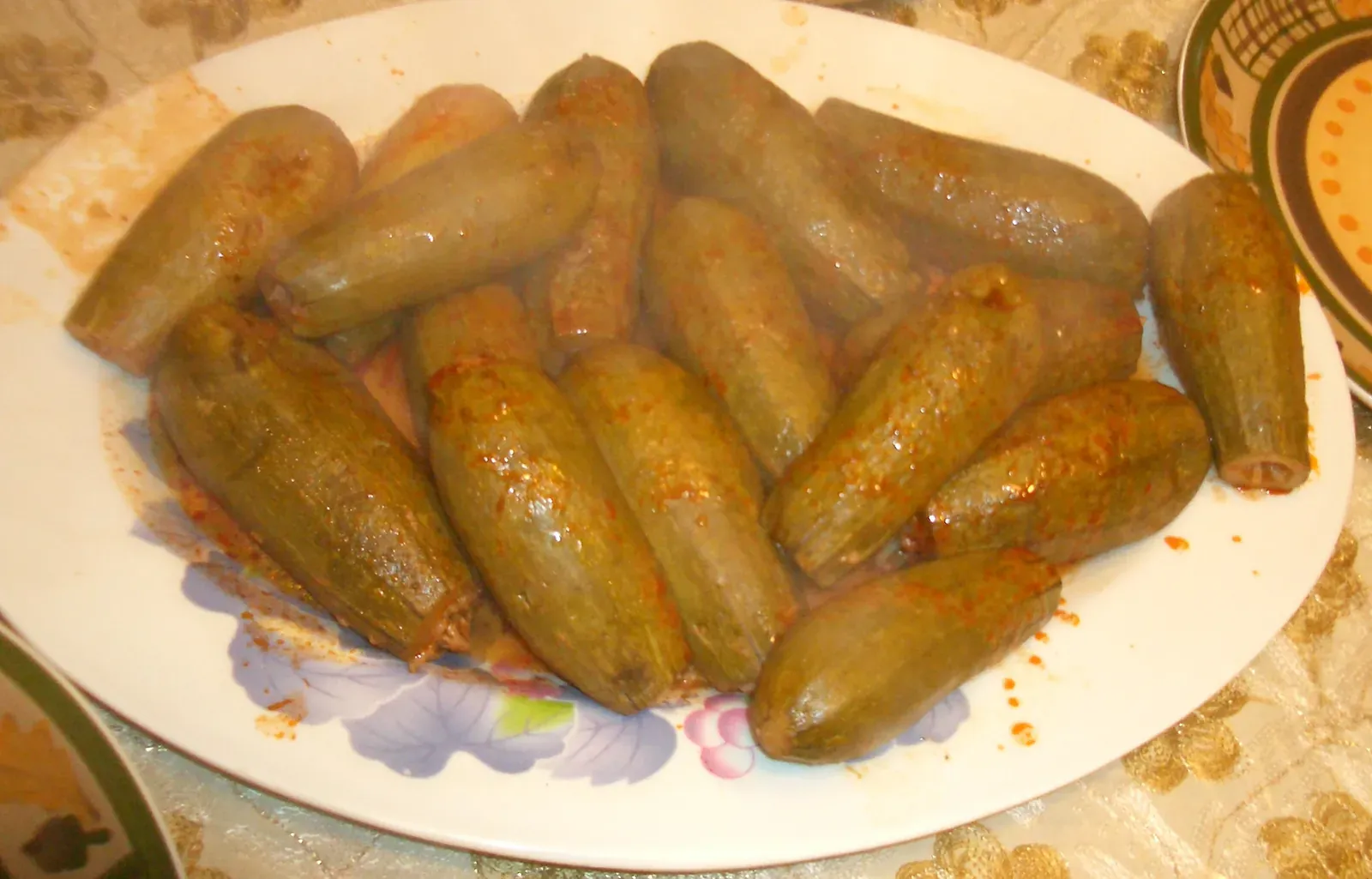
⚠️ Source-confidence note: Aleppo-style stuffing traits (tomato paste, sour notes from sumac/pomegranate molasses/tamarind, Aleppo pepper) are documented in Arabic recipe media and in an oral-history interview with a Syrian cook. I could not access Marlene Matar's The Aleppo Cookbook directly, so quantities below are a reconstruction from published Aleppo-style zucchini recipes.
01Geographic & Texture Profile
- Primary Geographic Zone: Aleppo (Halab), northern Syria; stuffed vegetables are cooked across Syria with city-specific fillings.
- Liquid & Texture Profile: Meloso (creamy): the rice inside the vegetables turns soft and saucy, cooked in a tart tomato broth.
- Traditional Cooking Vessel & Fuel: A wide, heavy pot; the stuffed vegetables are packed upright or in layers, weighted with a plate, and simmered on the stovetop.
02Historical & Cultural Context
Mahshi ("stuffed") is the Levant's great family of vegetables hollowed out and filled with rice: zucchini (kousa), aubergines, peppers, tomatoes, onions, cabbage leaves (malfouf) and vine leaves. Aleppo's version is the most strongly flavoured. The city's cooking, shaped by its trading past and its Armenian and Turkish neighbours, is described as more heavily seasoned than Damascus's, especially with red pepper. A Syrian cook interviewed by the University of Sussex sums up the difference: Aleppo uses tomato paste in the stuffing, while Damascus uses cumin and safflower. Arabic recipe media add the Aleppine sour signature: sumac, tamarind concentrate or pomegranate molasses, in the filling or the sauce.
Stuffed vegetables follow the seasons. In summer there are zucchini, aubergines and peppers. In winter cabbage leaves replace vine leaves (mahshi malfouf). Aleppo also has a bulgur-stuffed aubergine (mehshi al-burghul), a reminder that rice is the festive filling and bulgur the everyday one.
Culinary science: the rice goes in raw (washed, short-grain) and fills the vegetable only about three-quarters full, because it roughly doubles in volume as it absorbs the broth. Acid from sumac, pomegranate molasses or tamarind keeps the vegetable walls from collapsing, since pectin holds better in acidic liquid. The weighted plate stops the stuffing from escaping.
03Local Town-by-Town Variations
- Aleppo: Rice + minced meat + tomato paste + Aleppo pepper/allspice; sour broth (sumac, pomegranate molasses or tamarind; dried mint and garlic). Vegetables are often cooked in yogurt in other Aleppine dishes ⚠️ (yogurt-sauced kousa variant).
- Damascus: Filling seasoned with cumin and safflower rather than tomato paste; milder broth.
- Winter (all Syria): Mahshi malfouf: cabbage leaves rolled around the rice-and-meat filling, with garlic and lemon.
- Aleppo bulgur version: Mehshi al-burghul bi-zeit, aubergines filled with bulgur and vegetables, meatless.
04The Master Recipe (4-Person Batch Blueprint)
Variant represented: Aleppo kousa mahshi (zucchini) in a tart tomato broth.
The Flavor Base (El Fondo)
| Ingredient | Quantity |
|---|---|
| Small pale zucchini (kousa), cored | 1.2 kg (≈ 12–14) |
| Tomato paste (in filling) | 1 tbsp |
| Aleppo pepper | 1 tsp |
| Allspice / seven-spice | 1 tsp |
| Ghee or butter | 30 g |
| Broth: tomato paste 2 tbsp + crushed tomatoes 400 g + water 700 ml | — |
| Pomegranate molasses (or 2 tsp sumac / 1 tbsp tamarind) | 2 tbsp |
| Garlic, crushed with 1 tbsp dried mint | 4 cloves |
| Salt | to taste |
Assembly Ratios
| Element | Quantity |
|---|---|
| Short-grain rice (Egyptian/calrose), washed, raw | 200 g |
| Minced lamb or beef | 250 g |
| Rice : meat | ≈ 4 : 5 by weight |
| Fill level | ¾ of each vegetable |
Step-by-Step Cooking Blueprint
- Core: Hollow the zucchini with a corer (manqara), leaving 3–4 mm walls. Keep the pulp for another dish.
- Filling: Mix the raw rice, meat, tomato paste, Aleppo pepper, allspice, salt and melted ghee by hand.
- Stuff: Fill each zucchini three-quarters full; don't pack it.
- Pack: Lay the zucchini in the pot. Mix the broth ingredients and pomegranate molasses and pour over until just covered. Weight with an inverted plate.
- Simmer: Bring to a boil, then cook covered on low 45–50 min, until the rice is tender.
- Finish: Add the garlic-mint paste for the last 5 min. Rest 10 min and serve with the broth spooned over.
05Authority Reference Links
- Arabic Post – كوسة محشي على الطريقة الحلبية
- Arageek – طريقة عمل الكوسا محشي السوري (sumac / tamarind / pomegranate molasses)
- University of Sussex, Agricultural Voices – Razan's Story (Aleppo vs. Damascus stuffings, PDF)
- Aramco World (1975) – Meats and Sweets of Syria
- Orange Blossom Water – To Aleppo with Love: mehshi al-burghul bi-zeit az-zeitoun
- Mawdoo3 – طريقة عمل المحاشي
Foto: Bazel · Public domain · via Wikimedia Commons