⚠️ Source-confidence note: the dish, its ingredients, its etiquette and its 2022 UNESCO listing are well documented. Its history is contested: sources disagree on when rice replaced bulgur (late 19th century, late 1920s or the 1950s are all cited), and on how "traditional" the jameed version is. Town-level differences between Karak and Salt are claimed widely but poorly documented in print. Regional notes below say which parts are sourced and which are reconstructed. The quantities are a 4-person adaptation of a dish normally cooked for 12–14 people per tray.
01Geographic & Texture Profile
- Primary Geographic Zone: All of Jordan. The towns most famous for it are al-Karak (south) and al-Salt in al-Balqa (west-centre). It is also the main feast dish of the central and southern West Bank and the Naqab/Negev, and is eaten in southern Syria (Hauran).
- Liquid & Texture Profile: Seco (dry): fluffy, separate rice cooked dry, laid on shrak bread; the hot jameed (dried-yogurt) sauce is ladled over at the table, so each mouthful is moistened, not cooked, in the sauce.
- Traditional Cooking Vessel & Fuel: A large copper or aluminium cauldron (qidr) for the lamb and jameed over a wood fire, a separate pot for the rice, and the great round tray (sidr / minsaf) on which it is assembled and served. The dish takes its name from that tray.
02Historical & Cultural Context
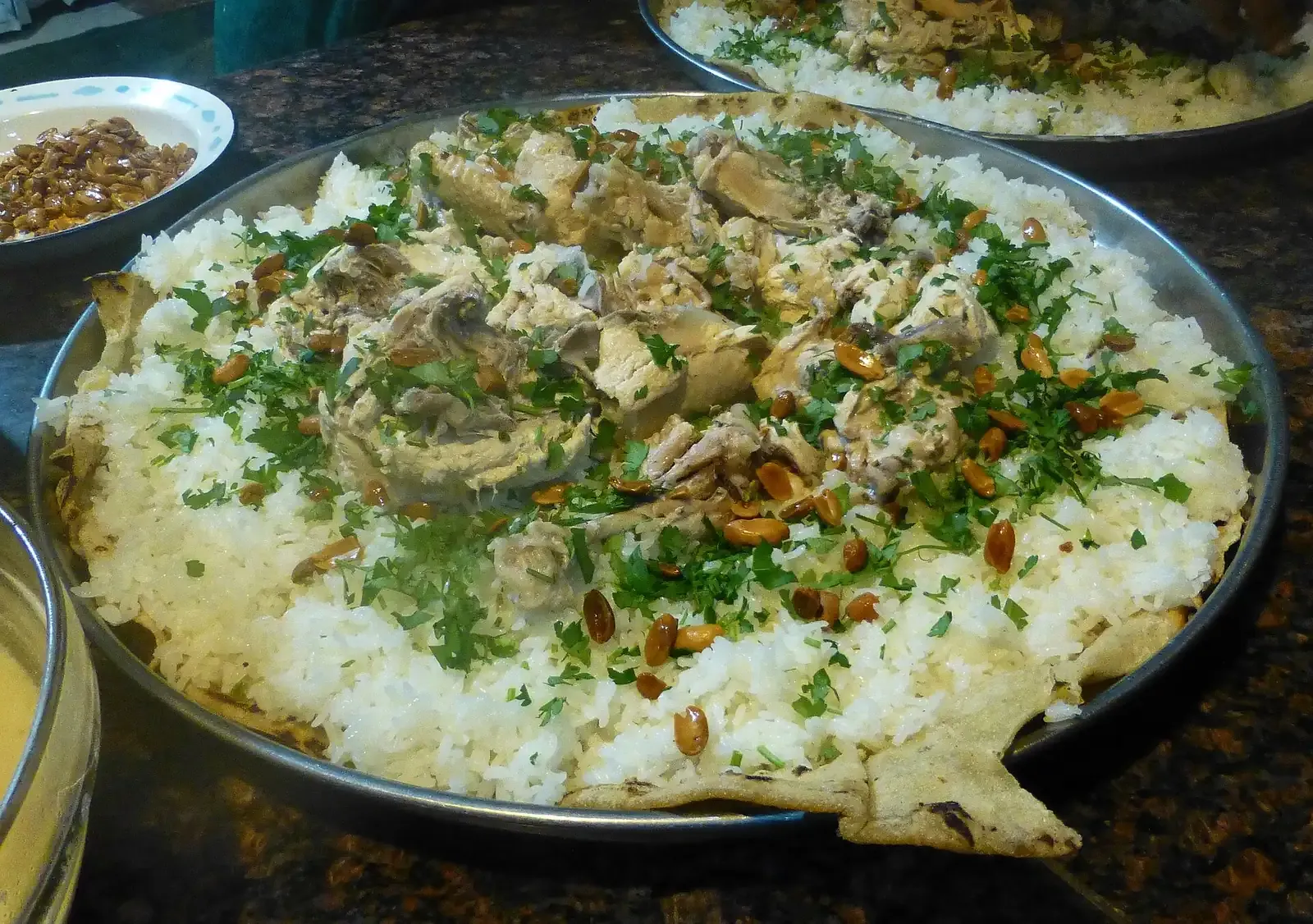
Mansaf is lamb (or, in older and Bedouin tradition, camel or goat) cooked in jameed, a sauce of reconstituted dried, salted, fermented yogurt. It is served on a huge tray over khubz shrak (paper-thin griddle bread) and a mound of rice, finished with clarified butter and toasted almonds and pine nuts. In 2022 UNESCO inscribed "Al-Mansaf in Jordan, a festive banquet and its social and cultural meanings" on the Representative List of the Intangible Cultural Heritage of Humanity. UNESCO describes it as central to weddings, funerals, religious feasts and the welcoming of guests, cooked communally and passed down mainly from women to daughters and granddaughters. It also has a formal role in tribal reconciliation ('atwa, jaha): a dispute is settled when the families share a mansaf.
The dish brings together the two halves of Jordanian rural life. Its yogurt comes from the herds of the Bedouin; its grain and bread come from the farming villages. A shepherd quoted by the Christian Science Monitor put it this way: "You need both desert and farms, village dwellers and Bedouins to make proper jameed and proper mansaf." Its form changed in the 20th century. Earlier versions were meat, broth or clarified butter, and bread, sometimes with bulgur as the grain. Rice spread into Transjordan as an imported grain and gradually replaced bulgur; the date is disputed. Jameed became the defining sauce as Bedouin groups settled, and almonds and pine nuts as a garnish are commonly dated to the 1960s. Jordanian folklore links the name to King Mesha of Moab (9th century BCE) cooking meat in milk to defy his enemies' dietary law. Jordanian historians quoted in the Arabic press present that as a told story, not a fact, and scholars such as Joseph Massad note that the state actively promoted mansaf as a national dish after independence.
Culinary science: jameed is yogurt strained, salted and sun-dried into hard balls, which preserves milk protein for the dry season. Reconstituted and blended, it gives a sour, salty, intensely savoury sauce. It curdles easily: casein clumps if boiled hard, so the sauce is stirred continuously, in one direction, as it heats and the lamb finishes in it. The rice is cooked plainly, fluffy and separate, often tinted with a little turmeric, so it can absorb the sauce at the table without turning to mush. The fat (samn baladi, clarified sheep's butter) carries the aroma of the toasted nuts and the spice blend (hwajeh / baharat).
03Local Town-by-Town Variations
- The Karak Style (al-Karak, the south): Built on jameed karaki, the most prized jameed in Jordan. In Karak villages such as Zahoum, families make it each spring from sheep's milk, shaping strained yogurt into fist-sized balls and drying them. Karak mansaf is reputed to be sharper and saltier, with a thicker sauce. ⚠️ The "sharper, thicker" characterisation is common oral lore, not documented in print.
- The Salt / Balqa Style (al-Salt, west-central): Salt shares Karak's reputation for the best mansaf. Its signature is the fat: samn balqawi, clarified butter named after al-Balqa governorate. ⚠️ Beyond the butter, no published source spells out a structural Salt–Karak difference. Treat claims that Salt "uses less jameed" or "more butter" as unverified.
- The Northern Style (Irbid, Ajloun, the Hauran): UNESCO records that in the north the tray is ringed with fried bulgur balls stuffed with minced meat (kubbeh), a reminder of the bulgur-based past. The north also eats shakriyeh / laban ummo, an urban cousin made with fresh rather than dried yogurt, sometimes with poultry, served with rice.
- The Bedouin / Old Style (desert, south and east): The documented older form is meat, broth or clarified butter, and shrak, with bulgur rather than rice, and in some groups without jameed at all. In some Bedouin villages men cook the meat and yogurt over an open fire while women prepare the grain and shrak in a separate tent.
- The Palestinian Style (central & southern West Bank, the Naqab/Negev): Mansaf is the main feast dish there too, eaten in the same way. Palestinian cooks often use laban jameed or liquid jameed and markook (similar to shrak) bread. See Palestine.
- The Aqaba Note (the Red Sea coast): A fish mansaf is reported around Aqaba. ⚠️ Only one secondary source mentions it, and it is not documented further. Aqaba's signature fish-and-rice dish is the coastal sayadieh.
| Variable | Karak | Salt / Balqa | North (Irbid, Ajloun) | Bedouin / older form |
|---|---|---|---|---|
| Sauce | Jameed karaki (sheep's milk) | Jameed + samn balqawi | Jameed; urban shakriyeh with fresh yogurt | Broth / samn, often no jameed |
| Grain | Rice | Rice | Rice; bulgur kubbeh around the tray | Bulgur (historically) |
| Bread | Shrak | Shrak | Shrak / markook | Shrak |
| Reputation | Sharpest jameed (oral) | Richest butter (oral) | Kubbeh garnish (UNESCO) | Simplest, oldest |
04The Master Recipe (4-Person Batch Blueprint)
Variant represented: Karak-style jameed mansaf with rice and shrak, scaled down from a 12–14-person tray. Quantities are reconstructed from Jordanian home and published recipes.
The Flavor Base (El Fondo)
| Ingredient | Quantity |
|---|---|
| Lamb, bone-in shoulder or leg, in large pieces | 1.3 kg |
| Water (blanching + simmering) | 3 L |
| Onion, halved | 1 |
| Bay leaves / cardamom pods / whole black pepper | 3 / 5 / 1 tsp |
| Dried jameed karaki (1 ball), broken and soaked overnight, or liquid jameed | 250 g dried / 750 ml liquid |
| Water to dissolve the jameed | 1 L |
| Hwajeh or Jordanian baharat (optional) | 1 tsp |
| Salt | taste only at the end: jameed is salty |
Assembly Ratios
| Element | Quantity |
|---|---|
| Short- or medium-grain rice (Egyptian / Calrose-type), rinsed | 400 g |
| Water for the rice (≈ 1.5 : 1 by weight) | 600 ml |
| Samn baladi (clarified sheep's butter) / ghee | 60 g |
| Ground turmeric | ¼ tsp |
| Khubz shrak (or markook / very thin flatbread) | 2–3 sheets |
| Blanched almonds + pine nuts, toasted in samn | 50 g + 30 g |
| Chopped parsley (optional) | 1 tbsp |
Step-by-Step Cooking Blueprint
- Preparation (night before): Break the jameed ball into pieces and soak it in water. Next day, blend it with its soaking water into a smooth, pourable sauce, about the texture of single cream, and strain it.
- Blanch the lamb: Cover with water, boil 5 min, discard the scum and water, rinse.
- Simmer: Cover again with ≈ 2.5 L water. Add the onion, bay, cardamom and pepper, and simmer covered 1 h 15 min until nearly tender. Keep the broth.
- Jameed: In a heavy pot, heat the jameed slowly, stirring constantly in one direction so it doesn't curdle. Add ≈ 500 ml of lamb broth to reach a thin-gravy consistency. When it simmers, add the lamb and cook together 20–30 min until the meat is very tender and the sauce lightly thickened. Taste for salt only now.
- Rice: Melt 20 g of the samn, stir in the rice and turmeric for 1 min, add the water and a pinch of salt, bring to a boil, then cover and cook on the lowest heat 15–18 min. Rest 5 min and fluff.
- Nuts: Toast the almonds and pine nuts in the remaining samn until golden. Keep the butter.
- Assembly: Line the tray with shrak and moisten it with a ladle of jameed. Mound the rice on top and set the lamb pieces on the rice. Pour over the nut butter and scatter the nuts and parsley.
- Serving: Bring the hot jameed to the table in a bowl and ladle it over each portion. Traditionally everyone eats standing around the tray, right hand only, forming the rice and sauce into balls.
05Authority Reference Links
- UNESCO – Al-Mansaf in Jordan, a festive banquet and its social and cultural meanings (2022)
- Jordan Times – Flavours of hospitality, tradition take Jordan's mansaf to world's table
- Arab News – UNESCO adds Jordanian mansaf to intangible cultural heritage list
- Christian Science Monitor – The secret behind Jordan's national dish? A "yogurt that unites" (Karak jameed makers)
- Emarat Al Youm (AR) – «المنسف» طبق وطني شعبي صمد عبر آلاف السنين (history, jameed karaki, samn balqawi)
- Asharq (AR) – «المنسف» طبق صمد آلاف السنين ويعد سيداً للمائدة الأردنية
- JustFood (AR) – طريقة عمل منسف كركي
- Wikipedia – Mansaf (history, Palestinian and northern variants, etiquette)
- Culture Trip – A brief history of mansaf, Jordan's national dish
- Saveur – Mansaf (Jordan's national dish), recipe
صورة: Ji-Elle · CC BY-SA 4.0 · عبر ويكيميديا كومنز