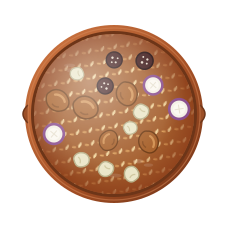
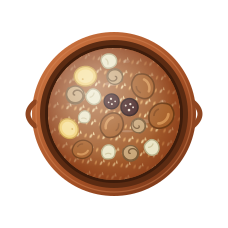
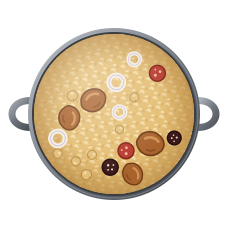
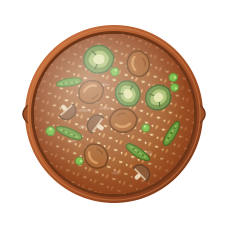
⚠️ Source-confidence note: a living home dish that is almost undocumented online. Written traces: (1) Directo al Paladar's survey of Orihuela's cooking lists arroz clarico among the huerta dishes, next to potajes and arroz con verduras; (2) an Orihuela reader on a Vega Baja recipe blog describes it as "a meat stew, cocido-style, with few chickpeas and compulsory hierbabuena (mint)", distinct from the Lenten arroz clarico de vigilia of Almoradí (see tres puñaos); (3) the user of this atlas reports it as a commonly cooked caldoso of the Vega Baja with a yellowish broth and mint. The Vega Baja comarca cookbook (CONVEGA) does not include it. The atlas user has also seen all the household variants listed in §3 cooked first-hand. Quantities below remain a reconstruction from comarca cocido practice.
01Geographic & Texture Profile
- Primary Geographic Zone: La Vega Baja del Segura: Orihuela and its huerta, with the same name heard in Almoradí (for the meatless vigil version). It probably extends into the Murcian huerta ⚠️.
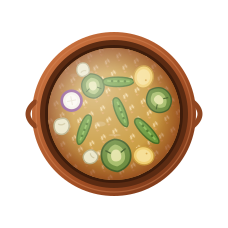
- Liquid & Texture Profile: Caldoso (soupy). A "clear" (clarico, diminutive of claro) yellow broth with the rice swimming in it, eaten with a spoon.
- Traditional Cooking Vessel & Fuel: A tall olla or cazuela on the hob, the same pot as the cocido.
02Historical & Cultural Context
The name says it all: clarico is the affectionate Vega Baja and Murcian diminutive of claro ("thin, clear"). It describes a rice cooked in an abundant, clear broth, as opposed to the thick legume potajes or the dry paellas. It belongs to the comarca's cocido culture: the same kitchens that make the Christmas cocido con pelotas and the olla gitana make an everyday clarico. Meat and bones are simmered with a small handful of chickpeas, and the broth is coloured yellow with saffron or, very commonly in modern homes, colorante. Rice is cooked directly in it. The defining aromatic is hierbabuena (spearmint). This is a Murcian-Vega Baja signature that links the dish to the mint-scented olla gitana and to the mint used in Vega Baja pelotas. It ultimately echoes the Andalusi use of fresh mint in broths.
The name collision is a textbook hyper-local case. In Orihuela, "arroz clarico" is this meat broth with mint. In Almoradí, "arroz clarico de vigilia" is the meatless Lent rice that Orihuela calls de los tres puñaos. The shared word, clarico, refers to the texture (a clear, soupy rice), not to any particular ingredient.
Culinary science: mint's aroma (carvone and limonene) is volatile and heat-sensitive. Long boiling flattens it into a dull herbal note, while adding it at the end keeps it bright. That's why most mint-scented Murcian stews add the hierbabuena in the last minutes, or leave a sprig in each bowl. Saffron's crocin is water-soluble and gives the "yellowish" broth. Colorante (tartrazine-type) reproduces the colour but not saffron's aroma.
03Local Town-by-Town Variations
The Orihuela Style (documented by an Orihuela reader): Meat broth "tipo cocido", few chickpeas, compulsory hierbabuena. Caldoso.
The Almoradí "clarico de vigilia" (Lent): Same name and texture, but no meat: beans, lentils, vegetables and rice. Documented separately as arroz de los tres puñaos.
Household variants (first-hand, atlas user's field observation in the Vega Baja): every one of the following is cooked in practice. The dish is a family of house styles rather than one fixed recipe:
Variable Option A Option B Meat Chicken or hen (gallina) Pork bones (espinazo) + magro or ribs (or both together) Potato With potato (thicker, more filling) Without potato (clearer broth, truer to the clarico name) Yellow colour Saffron threads Colorante (the everyday modern choice) Hierbabuena Added in the last minutes (bright, fresh mint) Simmered with the broth (softer, rounder herbal note) The written sources don't say which combination goes with which town. ⚠️ Whether pelotas go in on special days is still unconfirmed.
04The Master Recipe (4-Person Batch Blueprint)
Variant represented: Orihuela meat clarico, reconstructed. Swap freely between the §3 options: pork for hen, no potato, colorante for saffron, mint simmered from the start instead of at the end.
The Flavor Base (El Fondo)
| Ingredient | Quantity |
|---|---|
| Free-range chicken or hen (gallina), in pieces | 600 g |
| Pork bone (espinazo) + a piece of magro or rib | 300 g + 200 g |
| Chickpeas, soaked 12 h ("few") | 80–100 g |
| Potato, in chunks | 1 large (300 g) |
| Ripe tomato, halved (or grated) | 1 |
| Garlic | 2 cloves |
| Olive oil | 40 ml |
| Saffron threads (or colorante) | 0.2–0.3 g |
| Water | 3 L |
| Hierbabuena (fresh spearmint) | 1 good bunch (≈ 15 g) |
| Salt | to taste |
Assembly Ratios
| Element | Quantity |
|---|---|
| Round rice (Calasparra or Senia/Bahía) | 250–280 g |
| Broth at rice-in | ≈ 2 L (≈ 7–8 : 1, a clear caldoso) |
Step-by-Step Cooking Blueprint
- Cocido base: Put the chicken, pork bones, magro and soaked chickpeas into 3 L of cold water. Bring slowly to a boil and skim carefully, because a clear broth is the point. Simmer 1 h 15 min (or 30 min in a pressure cooker).
- Sofrito: In a pan, fry the garlic in the oil, then the tomato, for 5 min. Add it to the pot with the saffron and the potato. Simmer 15 min. The broth should now be golden-yellow.
- Meat: Lift out the bones, pick off the meat and return the meat to the pot. Correct the salt. You should have ≈ 2 L of broth.
- Rice: Bring to a lively simmer, add the rice and cook 16–17 min. Stir only gently, because the broth should stay clarico rather than starchy.
- Mint: In the last 2–3 minutes, add half the hierbabuena (whole sprigs). Remove it when serving, or leave it in if you like the stronger note.
- Finish: Serve immediately in deep plates with a fresh mint leaf or two in each. A caldoso doesn't rest.
05Authority Reference Links
- Directo al Paladar – La cocina de Orihuela ("arroz clarico" among the huerta dishes)
- Mercado Calabajío – Arroz de los 3 puñaos (comments: Orihuela's meat "arroz clarico" with compulsory hierbabuena vs. Almoradí's "clarico de vigilia")
- Los domingos cocino yo – Arroz clarico de vigilia (o de los tres "puñaos")
- CONVEGA – Recetario de la Vega Baja (PDF; comarca cocido & caldoso context)