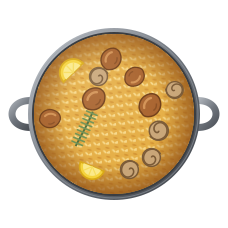
⚠️ Source-confidence note: a mountain rice with rabbit, snails and wild mushrooms is commonly cooked in the interior comarques of Castellón (Alt Millars/Alto Mijares, L'Alcalatén, Els Ports, Alt Maestrat), but I found no single documented canonical recipe. Tourism listings for towns such as Montanejos mainly cite "paella valenciana" and rabbit rices. This file reconstructs the shared structure from Valencian interior practice and flags where it does so. Verify with local restaurants or cookbooks.
01Geographic & Texture Profile
- Primary Geographic Zone: The Castellón interior: L'Alt Millars / Alto Mijares (Montanejos), L'Alcalatén (Llucena, L'Alcora), Els Ports (Morella), and L'Alt Maestrat.
- Liquid & Texture Profile: Seco (dry) in the paella. In the cold uplands of Els Ports it is often made caldoso instead.
- Traditional Cooking Vessel & Fuel: A steel paella over pine or holm-oak wood. In masías, a clay cassola on the hearth.
02Historical & Cultural Context
The Castellón interior is a high, cold, sparsely populated land of masías, livestock and hunting. Its rice brings together what the mountains supply: rabbit (wild or farmed), snails (vaquetes, caragols serrans), wild mushrooms in autumn (rovellons / níscalos, pebrassos), pork from the matança, and herbs (thyme, rosemary). Rice had to be bought down on the coast, which made it a festive ingredient up here, while the protein was local. It is the northern counterpart of the Alicante conejo y caracoles rice. The heat source changes (pine or oak instead of sarmiento), and mushrooms are added in season.
Culinary science: wild mushrooms release a lot of water and glutamates. Sautéing them separately until their liquid evaporates and they brown, then returning them at the end of the fondo, gives umami without a watery broth. Pine wood burns hot with resinous smoke, which marks the rice subtly.
03Local Town-by-Town Variations (Crucial — reconstructed, verify locally)
- Alto Mijares (Montanejos) Style: Rabbit + chicken + snails + green beans. Close to a paella valenciana with mountain herbs.
- L'Alcalatén Style: Rabbit + pork ribs + rovellons in autumn. Seco.
- Els Ports (Morella) Style: Colder climate, so it is often caldoso with lamb or pork and potato. The cecina or jamón of the area is sometimes included.
- Alt Maestrat Style: Rabbit + snails + thyme, very thin and dry, a mountain cousin of the Pinoso rice.
04The Master Recipe (4-Person Batch Blueprint)
Variant represented: L'Alcalatén / Alto Mijares autumn seco (rabbit + snails + rovellons).
The Flavor Base (El Fondo)
| Ingredient | Quantity |
|---|---|
| Rabbit, jointed | 1 (≈ 1.1 kg) |
| Pork ribs, short pieces | 250 g |
| Snails (vaquetes), purged & blanched | 24 |
| Rovellons / níscalos (or mixed wild mushrooms), cleaned, torn | 300 g |
| Olive oil | 100 ml |
| Garlic | 4 cloves |
| Ripe tomato, grated | 150 g |
| Pimentón dulce | 3 g |
| Thyme / rosemary | 1 sprig each |
| Water | 1.6 L |
| Saffron | 0.3 g |
Extraction: Sauté the mushrooms in 20 ml of the oil until browned and dry (6–8 min), then set aside. Brown the rabbit and ribs slowly (20 min). Add the garlic, pimentón (5 s) and tomato (5 min). Add the water, snails, herbs and saffron and simmer for 25 min, reducing to ≈ 1.2 L. Return the mushrooms for the last 5 min.
Assembly Ratios
| Element | Quantity |
|---|---|
| Short-grain rice | 380 g |
| Broth | ≈ 1.15–1.2 L |
| Rabbit + ribs | ≈ 1.35 kg |
| Mushrooms | 300 g |
Step-by-Step Cooking Blueprint
- Preparation: Purge the snails (3–5 days) and clean the mushrooms with a brush, not water.
- Fondo: As above.
- Rice: Scatter and level. Remove the herb sprigs.
- Fire (pine/oak): High for 8 min → embers for 8–9 min → brief flare for socarrat.
- Finish/Resting Phase: Rest 5 min.