01Geographic & Texture Profile
- Primary Geographic Zone: Barcelona and the Catalan coast (Maresme, Garraf), the Empordà (see arròs a la cassola de Pals), and the Camp de Tarragona.
- Liquid & Texture Profile: Meloso (creamy). The chef Maria Nicolau calls it "melós i suau" (creamy and smooth), and the opposite of a dry paella.
- Traditional Cooking Vessel & Fuel: A deep glazed earthenware cassola on a wood or coal stove, today on gas.
02Historical & Cultural Context
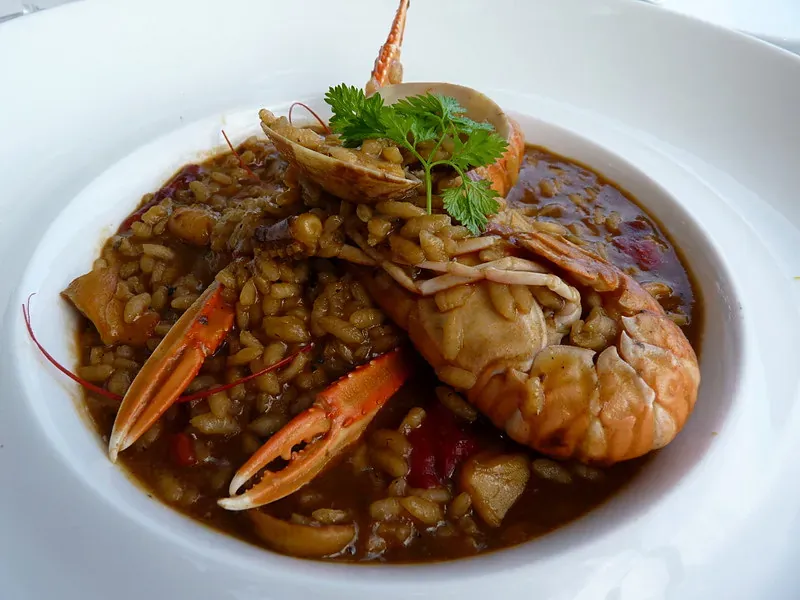
The Gran Enciclopèdia Catalana defines arròs a la cassola as rice cooked in a cassola "with fish, meat, poultry, vegetables, etc.", a dish that "admits many combinations". In Barcelona it was the Sunday and feast-day rice. VilaWeb notes that before canelons took over, many households ate arròs a la cassola on Sant Esteve (26 December). The TV3 Cuines reference recipe combines sofregit, meat and seafood: rabbit, pork, squid, mussels and langoustines, plus peas. This makes it the classic Catalan mar i muntanya ("sea and mountain") rice. Some writers, including Nicolau, argue for keeping the name "arròs a la cassola" rather than calling it a "paella".
Culinary science: the Catalan sofregit is the engine of this dish. Onion is cooked slowly for a long time until it is dark and jammy, then a little tomato is added; Nicolau warns against overdoing the tomato. A picada (pounded garlic, parsley, fried bread or almonds, sometimes saffron) is stirred in near the end to thicken and season. The deep clay cassola gives a thicker rice layer with gentle evaporation, which produces a creamy texture rather than a socarrat.
03Local Town-by-Town Variations
- Barcelona (TV3 reference): Rabbit + pork + squid + mussels + langoustines + peas. Onion sofregit. Picada.
- "Parellada" (Barcelona restaurant tradition): ⚠️ The parellada is traditionally described as a rice with all shells and bones removed, the Catalan counterpart of the senyoret. I found no primary source for it in this research, so verify.
- Empordà / Pals: Made with arròs de Pals, whose grains stay loose. See recipe_arros_a_la_cassola_de_pals.md.
- Palamós (cuina de barca): A fishermen's version cooked with the day's catch. The Museu de la Pesca cookery school demonstrates it.
04The Master Recipe (4-Person Batch Blueprint)
Variant represented: Barcelona mar i muntanya (structure of the TV3 reference recipe).
The Flavor Base (El Fondo)
| Ingredient | Quantity |
|---|---|
| Olive oil | 80 ml |
| Rabbit, small pieces | 400 g |
| Pork ribs or loin | 250 g |
| Squid, rings | 250 g |
| Onion, finely chopped | 2 (300 g) |
| Ripe tomato, grated | 100 g |
| Fish and meat stock | 1.4 L |
| Mussels | 300 g |
| Langoustines | 8 |
| Peas | 120 g |
| Picada: garlic 2 cloves, parsley, 10 toasted almonds or 1 slice fried bread, saffron 0.2 g | — |
Extraction: Brown the rabbit and pork (12 min) and set aside. Sear the squid (3 min). Add the onion and cook slowly until dark (20–25 min), then the tomato (5 min). Return the meats. Open the mussels separately in a lidded pan and keep their liquid for the stock.
Assembly Ratios
| Element | Quantity |
|---|---|
| Rice (bomba or Pals/Delta) | 320 g |
| Stock | ≈ 1.2–1.3 L (≈ 4:1, meloso) |
Step-by-Step Cooking Blueprint
- Add the rice to the sofregit and stir for 1 min.
- Add the boiling stock and the peas.
- Simmer 10 min, then stir in the picada. Lay the langoustines on top.
- Cook another 6–7 min, shaking the cassola instead of stirring. Add the mussels at the end.
- Rest 2 min, covered. The rice should be loose and creamy.
05Authority Reference Links
- 3Cat Cuines – Arròs a la cassola (TV3)
- Enciclopèdia Catalana – Arròs
- NacióDigital – Els consells de Maria Nicolau per fer un bon arròs
- VilaWeb – La història real dels canelons de Sant Esteve (arròs a la cassola tradition)
- Costa Brava Lifestyle – Palamós cookery school (arròs a la cassola)
صورة: e_calamar · CC BY 2.0 · عبر ويكيميديا كومنز